
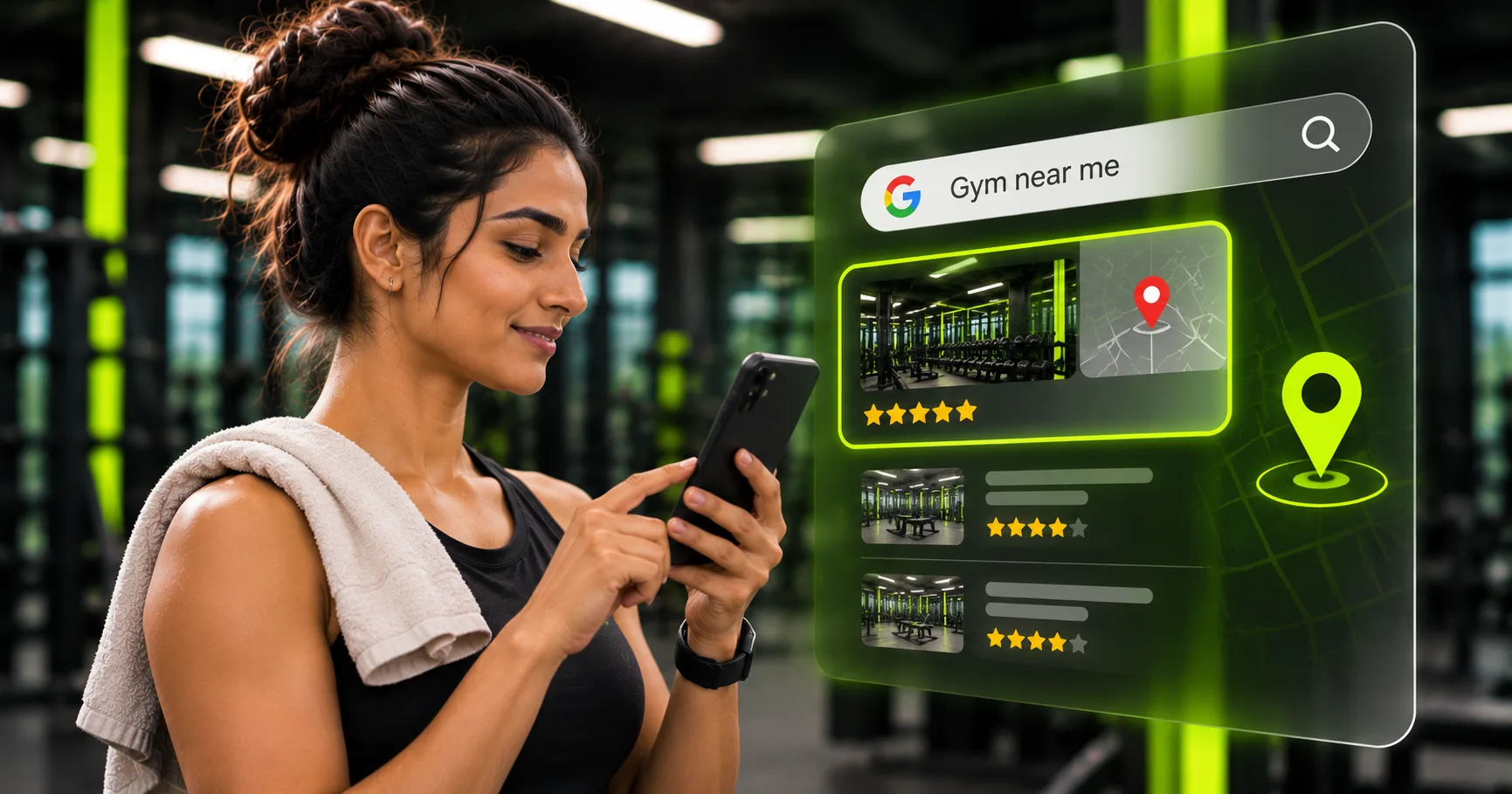
When an urban Indian professional decides to join a gym, their journey rarely begins with an Instagram ad or a paper flyer. Over 80% of high-intent fitness buyers begin their search by pulling out their smartphone, opening Google Maps, and typing three high-stakes words: 'Gym Near Me'. Within milliseconds, Google's local algorithm displays the famous 'Local 3-Pack'—the top three gym listings matching the user's geographic location, complete with star ratings, photo previews, operating hours, and direct call buttons.
Securing a spot in this coveted Local 3-Pack is the holy grail of fitness marketing. The top three positions capture over 70% of all local phone calls, website clicks, and in-person walk-ins. Better yet, these are not passive social media scrollers who need to be convinced to exercise; these are active, pre-qualified prospects holding their wallets, searching for a facility to join today. Despite this massive commercial prize, over 90% of Indian fitness centers treat their Google Business Profile (GBP) as an afterthought—leaving categories incomplete, posting low-resolution photos, ignoring customer reviews, and missing out on lakhs in high-margin organic membership revenue.
The Mechanics of Google's Local Search Algorithm: Prominence, Relevance & Proximity
Google evaluates local fitness listings through three core algorithmic pillars. Understanding these mechanics is essential to outranking well-funded franchise competitors:
1. Relevance: How accurately your profile matches the searcher's intent. If a prospect searches for 'CrossFit gym with steam bath near me', and your profile explicitly lists CrossFit, group functional training, and luxury steam amenities in your primary services, Google rewards you with higher search visibility.
2. Proximity: The physical distance between the searcher's GPS coordinates and your facility address. While you cannot change your physical location, optimizing your service area keywords and building localized geo-tagged photo signals expands your ranking radius from 500 meters to over 5 kilometers.
3. Prominence: How well-known, authoritative, and reputable your gym is online. Prominence is heavily weighted by three factors: total volume of authentic 5-star Google reviews, review velocity (consistent weekly influx of fresh reviews), and external NAP (Name, Address, Phone) citation consistency across business directories.
Neglected Profile vs. High-Ranking Optimized GBP Listing
Here is an operational comparison between an amateur gym profile and a dominant, optimized Google Business listing:
| Optimization Asset | Neglected Amateur Gym Profile | Gympify Optimized Google Business Profile |
|---|---|---|
| Category Selection | Single generic category: 'Gym'. Misses dozens of sub-niche searches. | Primary: 'Gymnasium'. Secondary: 'Fitness Center', 'Personal Trainer', 'Yoga Studio'. |
| Review Generation | Staff beg friends for 10 fake reviews at launch; zero organic flow afterward. | Automated post-workout WhatsApp review triggers generate 15+ verified reviews weekly. |
| Review Response Protocol | Ignored completely, or defensive one-sentence arguments on negative reviews. | 100% of reviews answered professionally within 24 hours incorporating SEO keywords. |
| Visual Media & Photos | 3 blurry photos taken on a dusty phone camera from 2021. | 100+ professional HDR photos, 360-degree virtual tour, and weekly equipment updates. |
| Direct CTA Integration | Generic home page URL; caller encounters an unanswered landline. | Direct deep-link to instant 1-Day Trial QR pass and integrated WhatsApp chat button. |
The Step-by-Step Blueprint to Dominating 'Gym Near Me' Rankings
Outranking regional competitors requires executing a systematic, multi-stage local optimization playbook.
Step 1: Flawless Name, Address & Phone (NAP) Consistency
Never stuff your official business title with spammy keywords (e.g., 'NitroFit Gym Best Gym Heavy Weights Treadmill Koramangala'). Google's automated spam algorithms frequently suspend listings with blatant keyword stuffing. Use your clean, official brand name (e.g., 'NitroFit Gym - Koramangala'). Ensure your exact street address, PIN code, and mobile phone number match 100% identically across your website, Facebook page, Justdial, and local chamber of commerce directories.
Step 2: Maximize Primary and Secondary Category Taxonomies
Google allows one Primary Category and up to nine Secondary Categories. Choose carefully: - Primary Category: 'Gymnasium' or 'Fitness Center' (this carries 60% of category ranking weight). - Secondary Categories: 'Personal Trainer', 'Yoga Studio', 'Body Shaping Class', 'Sports Club', 'Aerobics Program'. Complete every service attribute: specify air conditioning, free Wi-Fi, gender-specific locker rooms, wheelchair accessibility, and credit card acceptance.
Step 3: Build an Automated Review Generation Engine
Reviews are the #1 local ranking factor in competitive urban markets. But members rarely leave reviews spontaneously unless prompted at the perfect emotional moment. With Gympify, configure automated review triggers: - When a member checks in for their 20th workout, or when their trainer logs a 3 kg fat loss milestone, Gympify dispatches an automated WhatsApp alert: 'Amit, we love seeing your incredible dedication at NitroFit! Could you take 20 seconds to share your experience on Google? It helps other locals discover healthy habits: [Direct Review Deep-Link].' This single automated workflow generates 40 to 60 verified 5-star reviews every single month, propelling your listing to #1.
Step 4: Upload High-Resolution Visuals & Virtual Floor Tours
Listings with over 100 photos receive 520% more calls and 1,065% more website clicks than average businesses. Upload professional photography covering: - Exterior building signage and parking area (removes arrival anxiety). - Cardio deck with panoramic views and clean selectorized strength lines. - Pristine, sanitized locker rooms, showers, and steam suites. - High-energy group fitness classes in action with vibrant lighting. Add 5 new photos every Friday to signal continuous freshness to Google's ranking crawlers.
Step 5: Publish Weekly Google Business Updates
Treat your Google profile like a mini-social media feed. Post weekly 'Updates' highlighting member transformation spotlights, weekend masterclass schedules, and special seasonal trial passes. Google indexes the text inside these posts, helping your profile rank for long-tail search queries like 'Zumba classes near me' or 'HIIT bootcamp this Saturday.'
Handling Unfair Negative Reviews with Grace
Inevitably, your gym will receive a 1-star review—often from an unruly non-member who was reprimanded for dropping weights, or from a disgruntled competitor. Never reply angrily or make defensive accusations. Reply with clinical professionalism: 'Hi Rahul, thank you for sharing your feedback. We maintain strict equipment safety and sanitation standards for all our 500+ active members. We would welcome the opportunity to learn more about your visit. Please connect directly with our General Manager at [email protected] so we can address your concerns.' Prospective members reading your response will judge your brand by your maturity and hospitality.
Key Operational Takeaway
Dominating 'Gym Near Me' searches on Google Maps is the most profitable organic marketing channel in the fitness industry. By optimizing categories, deploying automated post-workout review requests, and maintaining active weekly visual updates, your gym will capture over 70% of high-intent local fitness traffic without paying for ads. To automate review collection and local SEO workflows, explore Gympify marketing features or request a local search audit today.
Related Operational Guides
Accelerate your gym's local customer acquisition with these interconnected marketing resources:
- Hyperlocal Meta Ads & WhatsApp Lead Funnels: Combine organic Google search with targeted Instagram campaigns.
- Gym Lead Management & CRM Pipelines: Convert organic Google phone calls into scheduled facility tours.
- Gym Member Referral Engines: The Workout Buddy Framework: Turn organic search joiners into referral ambassadors.
Frequently Asked Questions
How long does it take for a gym to rank in the Google Local 3-Pack?
In moderately competitive localities, systematic optimization—including category refinement, uploading 50+ photos, and generating 25+ authentic 5-star reviews—typically propels a gym into the top 3 rankings within 60 to 90 days.
Can we incentivize members with protein bars or discounts to leave Google reviews?
No. Google’s official Terms of Service strictly prohibit offering financial compensation, discounts, or gifts in exchange for reviews. Doing so risks algorithmic penalties or total profile suspension. Instead, prompt members at natural emotional milestones (such as hitting workout streaks or weight loss goals).
How do we handle fake negative reviews from rival competitors?
Flag the review immediately inside your Google Business dashboard under 'Conflict of Interest' or 'Off-Topic.' Submit evidence to Google Support demonstrating the reviewer was never a registered member in your database, while posting a calm, professional public response in the interim.
Should we create separate Google listings for personal training and yoga within the gym?
Only if they have distinct physical entrances, separate legal registration, and unique phone numbers. Creating duplicate listings for departments at the same address violates Google guidelines and risks getting your primary gym profile suspended.