
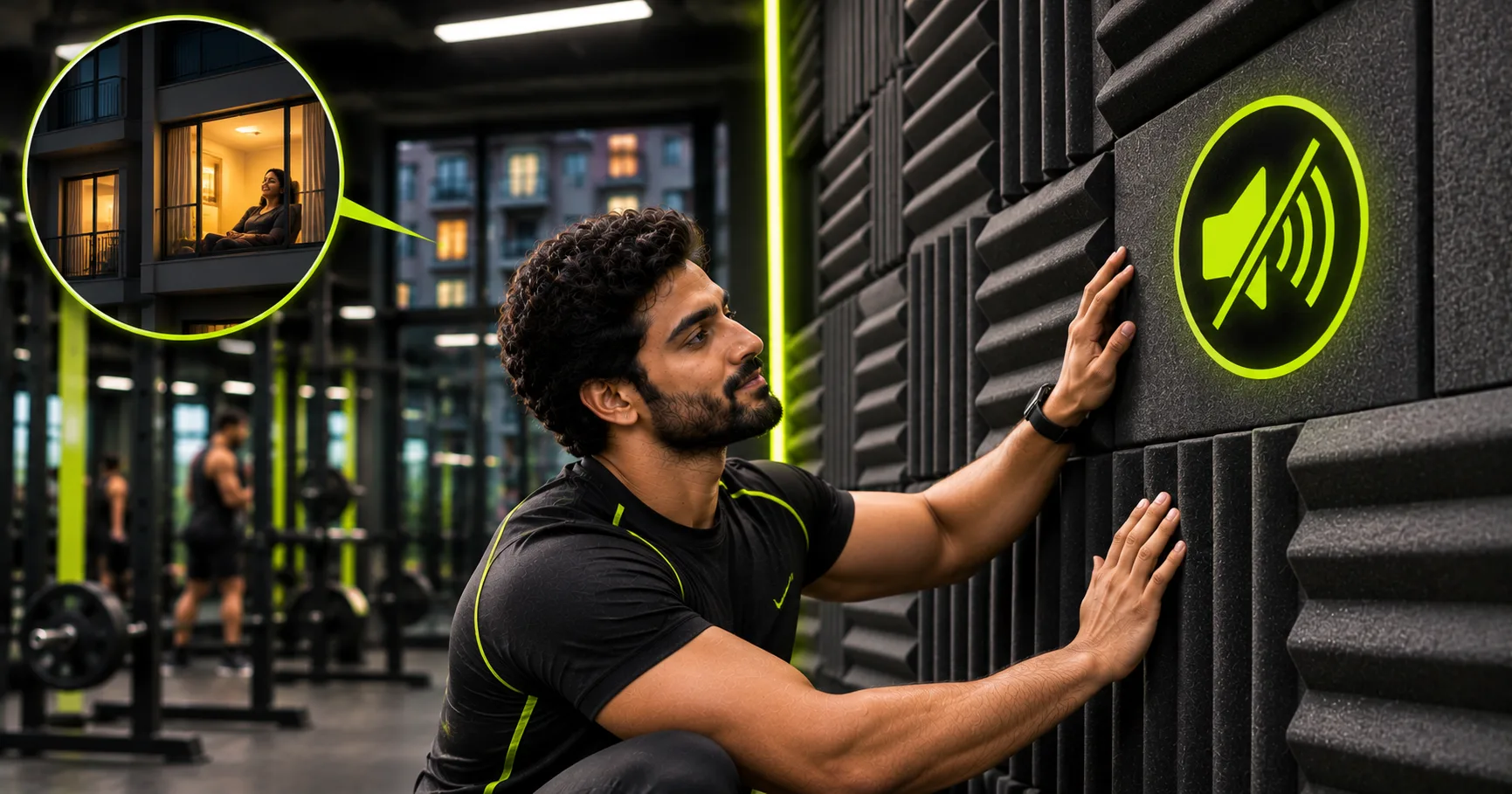
Opening a commercial fitness center or CrossFit box on the upper floors of a modern Indian mixed-use commercial-residential complex—such as in Mumbai's Bandra, Bengaluru's Indiranagar, or Delhi's Greater Kailash—offers incredible footfall and affluent neighborhood demographics. Yet, within thirty days of grand opening, dozens of gym owners find their dream business plunged into an existential legal crisis: furious residential neighbors from the apartments below storming reception, petitioning the Resident Welfare Association (RWA), calling the local police station to file public nuisance complaints, or threatening the commercial landlord with litigation.
The conflict is almost always triggered by two acoustic enemies: low-frequency structure-borne vibration from dropped heavy deadlifts and high-decibel acoustic bass reverberation from group fitness sound systems. Traditional foam tiles and budget rubber rolls provide zero isolation against 150-kilogram barbells slamming into reinforced concrete floor slabs. Without professional acoustic decoupling, impact energy travels directly through the building's concrete columns, vibrating residents' chandeliers, cracking tile grout below, and generating unbearable sub-bass thuds. Solving this requires understanding Sound Transmission Class (STC) and Impact Insulation Class (IIC) engineering.
The Physics of Gym Noise: Airborne vs. Structure-Borne Impact
To eliminate noise complaints permanently, gym owners must distinguish between the two distinct physical mechanisms of sound transmission:
1. Airborne Sound (Music, Shouting, Voice): Sound waves traveling through air molecules—such as 90-decibel EDM tracks during an evening spin class or coaches barking instructions. Airborne noise penetrates through thin glass windows, unsealed HVAC duct penetrations, hollow wooden doors, and uninsulated partition walls. It is governed by Sound Transmission Class (STC) ratings.
2. Structure-Borne Vibration (Impact Sound): Mechanical kinetic energy generated when solid mass collides with solid floor—specifically heavy barbell deadlifts, dropped dumbbells, jumping plyometrics, and treadmill motor foot strikes. When a 140 kg barbell drops from hip height, it generates a kinetic shockwave that enters the reinforced concrete slab. Concrete is an exceptional acoustic conductor; the vibration travels unimpeded through concrete beams and pillars, radiating as loud acoustic noise into apartments two or three floors away. It is governed by Impact Insulation Class (IIC) ratings.
Amateur Flooring vs. Engineered Decoupled Acoustic Platforms
Why do standard gym rubber mats fail? Because dense solid rubber merely transfers kinetic energy into the floor. Here is an operational comparison:
| Acoustic Metric | Standard 10mm Commercial Rubber Rolls | Gympify Decoupled Multi-Layer Drop System |
|---|---|---|
| Deadlift Impact Decibel Reduction | Minimal; reduces impact noise by barely 3 to 5 decibels (dBA). | Massive; reduces structure-borne peak impact by 28 to 36 dBA. |
| Vibration Decoupling Mechanism | Solid rubber; compresses solid-to-solid, transferring shock directly into slab. | Dual-density decoupled system: high-density rubber over open-cell acoustic foam. |
| Bass Music Reverberation (RT60) | Uncontrolled; mirrors and concrete create echo chamber with 2.8s reverberation. | Treated with fabric-wrapped acoustic wall panels; RT60 controlled beneath 0.8s. |
| RWA / Police Complaint Risk | Extremely high; results in evening operating bans or forced relocation. | Zero complaints; neighbors below hear zero vibration even during peak hours. |
| Concrete Slab Integrity | Over 18 months, micro-fractures develop in landlord's concrete structural slab. | 100% protected; kinetic energy absorbed and dissipated as internal heat. |
The Step-by-Step Blueprint to Soundproofing a Commercial Gym
Eliminating neighbor noise friction requires combining mechanical floor decoupling with acoustic wall treatments.
Step 1: Install Multi-Layer Decoupled Deadlift Drop Zones
Never permit heavy deadlifting or Olympic weightlifting directly on standard 10mm or 15mm gym flooring. In heavy free-weight zones, construct an engineered Decoupled Multi-Layer Platform: - Layer 1 (Subfloor Isolation): 50mm open-cell high-damping acoustic foam pads (e.g., Sylomer or specialized recycled tire polyurethane foam). - Layer 2 (Mass Distribution): Two staggered layers of 18mm high-density Marine Plywood cross-screwed together to distribute point-load impacts across a wide surface area. - Layer 3 (Surface Impact Absorption): 30mm high-density vulcanized ballistic rubber tiles or specialized 'Drop Zone' crumb rubber mats. This three-layer sandwich absorbs 95% of kinetic energy, preventing shockwaves from ever touching the building's concrete slab.
Step 2: Decouple Audio Subwoofers with Isolator Pads
One of the most common causes of noise complaints is commercial audio subwoofers placed directly on the floor. The bass vibrations travel straight through the floorboards. Never place subwoofers on the bare floor: - Mount subwoofers on heavy-duty acoustic elastomer isolation feet (e.g., Sorbothane or Auralex SubDude pads). - Alternatively, hang subwoofers from structural ceiling beams using vibration-damping aircraft cables and rubberized spring hangers.
Step 3: Treat Wall Reverberation with Acoustic Baffles
Large fitness floors lined with floor-to-ceiling glass mirrors, polished concrete, and metal ceiling decks create an acoustic echo chamber. Sound reverberates endlessly, forcing trainers to crank sound systems to 95 decibels just to be heard. Install fabric-wrapped fiberglass acoustic panels (minimum 50mm thickness with NRC rating >0.85) on 30% of wall surfaces, or hang cylindrical acoustic baffles from open ceilings. Controlling reverberation allows trainers to deliver high-energy classes at comfortable 75-decibel levels with crystal-clear vocal clarity.
Step 4: Establish Floor Etiquette & Chalk Drop Guidelines
Complement engineering with floor culture: - Mandate rubber-coated bumper plates or urethane Olympic plates in all deadlift zones (strictly ban bare cast-iron plates on upper-floor gyms). - Provide portable high-density foam Drop Crash Pads (Silencer Pads) for powerlifters practicing heavy singles over 180 kg. - Train floor trainers to politely educate members: 'Control the eccentric phase of your lift down to the platform.'
Legal Defense: Maintaining Certified Decibel Audit Logs
Indian municipal noise regulations (under The Noise Pollution Regulation and Control Rules, 2000) specify commercial ambient noise limits: 65 dBA during daytime and 55 dBA at nighttime. Protect your gym against frivolous RWA harassment by hiring a certified acoustic engineer to perform baseline noise and vibration audits inside neighboring apartments during live workout drops. Keep this signed acoustic compliance certificate at your reception desk to resolve disputes immediately when authorities visit.
Key Operational Takeaway
Neighbor complaints and legal disputes over gym noise can shut down your facility overnight. Investing in decoupled deadlift platforms, subwoofer isolation pads, and acoustic wall baffles stops structure-borne vibration at the source, preserves your commercial lease, and ensures harmonious community operations. To learn more about modern facility design and operational excellence, explore Gympify's management modules or consult with our operations team today.
Related Operational Guides
Protect your gym's physical facility and operational compliance with these interconnected guides:
- Powerlifting Gym Barbell Care & Deadlift Platforms: Design heavy-duty lifting platforms that protect floors.
- Gym Indoor Air Quality & Ventilation: Integrate quiet, decoupled HVAC duct silencers.
- Gym Membership Terms & Legal Protections: Protect your business against regulatory complaints and disputes.
Frequently Asked Questions
Why do standard 15mm rubber gym tiles fail to stop deadlift vibration?
Standard rubber tiles are dense and lack open-cell air pockets. When a heavy barbell drops, the rubber compresses completely and transfers the kinetic shockwave directly into the concrete floor slab, vibrating the entire building structure.
What is the legal noise decibel limit for commercial gyms in India?
Under Indian Noise Pollution Rules, commercial zones are limited to 65 dBA daytime (6 AM - 10 PM) and 55 dBA nighttime. In mixed commercial-residential zones, noise transmitting into neighboring residences must not exceed 55 dBA daytime and 45 dBA nighttime.
How can we stop bass vibration from group fitness sound systems?
Physically decouple your subwoofers from the floor using acoustic isolation elastomer pads (e.g., Sorbothane) or suspend them from ceiling joists using vibration-isolating spring brackets, preventing bass frequencies from entering structural slabs.
What are 'Crash Pads' or 'Silencer Drop Pads' in powerlifting gyms?
Crash pads are portable, high-density 15cm-thick foam blocks placed under barbell plates during deadlifts or Olympic cleans. They absorb virtually 100% of barbell drop impact sound and vibration, making heavy lifting silent.