
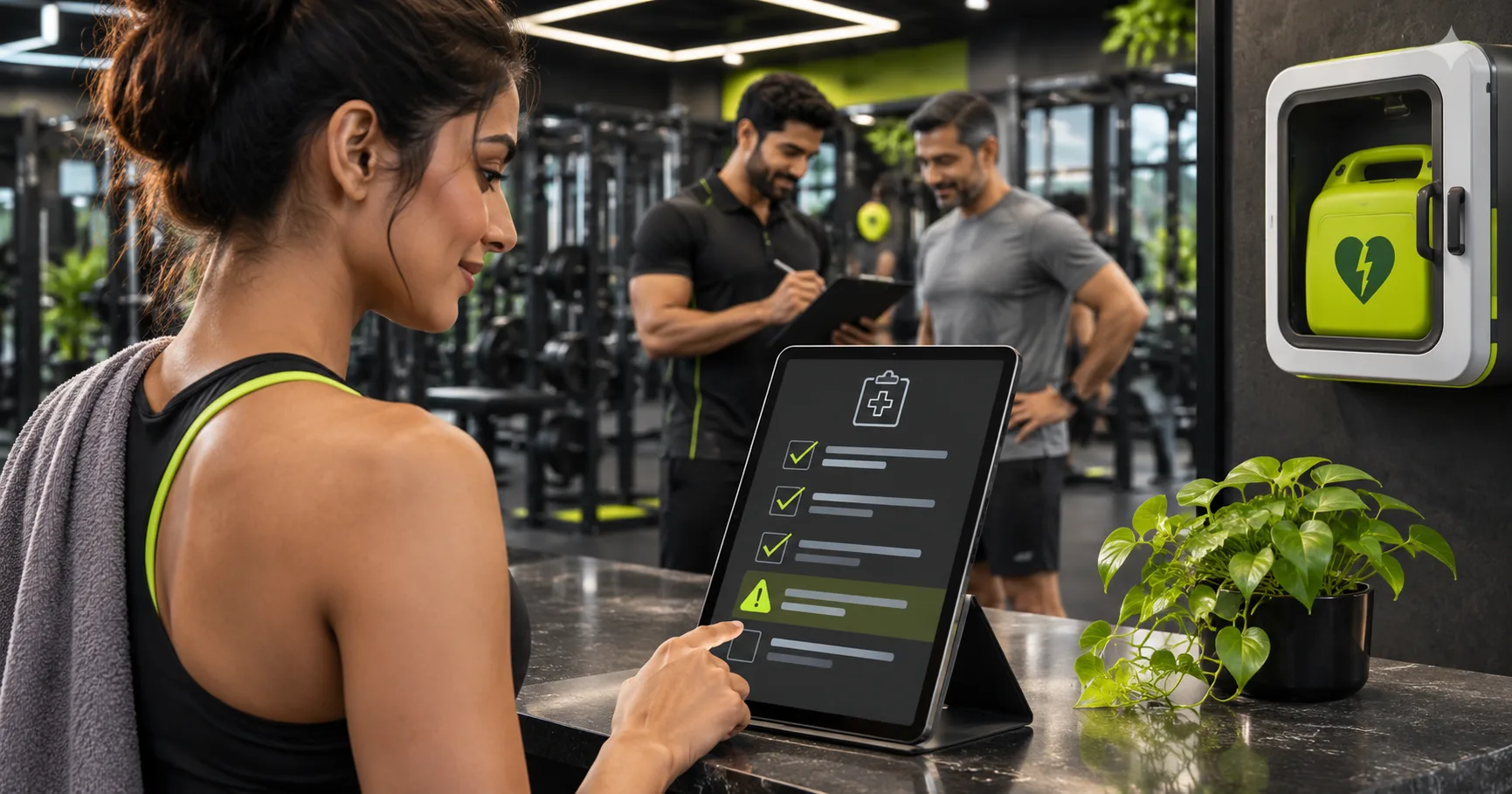
Over the past three years, the Indian fitness industry has been shaken by a tragic, deeply alarming series of high-profile medical catastrophes: seemingly healthy young individuals, corporate executives, and celebrities suddenly collapsing on commercial gym treadmills from Sudden Cardiac Arrest (SCA) during or immediately following intense physical exertion. Every time an incident occurs, national media erupts with sensational headlines, regulatory scrutiny intensifies, and public trust in commercial gyms wavers.
When a medical emergency or severe physical injury occurs on a gym floor, the immediate question posed by police investigators, consumer protection commissions, and grieving families is uncompromising: Did the gym conduct a mandatory medical health screening prior to granting access, and did the member execute a legally binding liability waiver? In over 80% of independent Indian fitness centers, the answer is a terrifying 'No.' Health assessments are skipped in the rush to collect fees, or paper waivers are scribbled with illegible signatures and lost in unorganized reception drawers. Deploying a mandatory Digital PAR-Q+ (Physical Activity Readiness Questionnaire) and Legally Binding E-Waiver Protocol is not an administrative nuisance—it is an existential operational shield that saves member lives and protects gym founders from criminal negligence and financial ruin.
The Medical Reality: Asymptomatic Cardiovascular Risks in Urban Lifters
To appreciate the urgency of pre-exercise health screening, look at modern epidemiological data in urban India. Urban Indians possess the highest genetic susceptibility to premature coronary artery disease (CAD) in the world—often developing acute arterial plaque and endothelial dysfunction ten to fifteen years earlier than Western counterparts.
Compounding this genetic predisposition is modern lifestyle stress: chronic sleep deprivation, heavy corporate caffeine and energy drink consumption, post-COVID myocardial inflammation, and the rampant unmonitored use of underground pre-workout stimulants containing excessive dosages of DMAA, ephedra, or dangerous vasoconstrictors. When an individual with undiagnosed hypertrophic cardiomyopathy or silent arterial blockage attempts maximum-heart-rate treadmill sprints or 200 kg leg presses without medical clearance, the sudden surge in catecholamines and arterial blood pressure can trigger ventricular fibrillation and fatal cardiac arrest. A professional gym must identify these high-risk individuals before they ever step onto a treadmill.
Paper Waivers vs. Gympify Digital Health Screening & E-Waiver Architecture
Here is an operational comparison between the vulnerable traditional paper clipboard system and Gympify's automated health screening framework:
| Legal & Screening Dimension | Legacy Paper Clipboard Waiver | Gympify Automated Digital PAR-Q+ System |
|---|---|---|
| Screening Adherence | Skipped for 70% of walk-ins; staff treat it as annoying paperwork. | 100% Mandatory Gating; turnstile will not unlock until PAR-Q+ is completed. |
| Clinical Screening Depth | Vague one-line statement: 'I confirm I am healthy.' Legally indefensible. | Standardized international 7-Question PAR-Q+ with automated medical risk triage. |
| High-Risk Medical Flagging | Ignored; untrained receptionists do not understand medical red flags. | Algorithmic lock: any 'YES' answer triggers automated Physician Clearance workflow. |
| Signature Validity & Tamper-Proofing | Scribbled paper; easily lost, water-damaged, or challenged in court as forged. | Cryptographic digital signature with timestamped IP, SMS OTP, and cloud PDF storage. |
| Emergency Contact Availability | Buried in physical filing cabinets; takes 20 minutes to find during a crisis. | 1-Click instant emergency contact dialing directly on staff mobile apps. |
The Step-by-Step Blueprint to Implementing a Medical-Grade Safety Protocol
Safeguarding your gym against medical emergencies requires integrating digital health questionnaires, AED hardware, and staff emergency training.
Step 1: Enforce Digital PAR-Q+ Completion at Onboarding
Never hand out a physical clipboard. During member enrollment on Gympify, the member completes the international PAR-Q+ (Physical Activity Readiness Questionnaire for Everyone) on a dedicated counter tablet or via an instant WhatsApp link on their own phone. The screening asks seven critical clinical diagnostic questions: 1. Has your doctor ever said that you have a heart condition or high blood pressure? 2. Do you feel pain in your chest at rest, during daily activities, or when you exercise? 3. Do you lose balance because of dizziness, or have you ever lost consciousness? 4. Have you ever been diagnosed with a chronic medical condition (diabetes, asthma, epilepsy)? 5. Are you currently taking prescribed medications for blood pressure or a heart condition? 6. Do you have a bone, joint, or spinal problem that could be made worse by exercise? 7. Has your doctor ever said that you should only exercise under direct medical supervision?
Step 2: Automate the 'Physician Medical Clearance' Gate
If the applicant answers 'NO' to all seven questions, they proceed directly to execute the digital liability waiver. However, if the applicant answers 'YES' to any question, Gympify triggers an automated safety protocol: - The member's account is automatically tagged as 'Pending Medical Clearance.' - Biometric turnstile access remains locked for high-intensity training zones. - The system automatically generates a pre-formatted 'Physician Physical Activity Readiness Clearance Form' sent to the member's WhatsApp. The member takes the form to their treating physician (cardiologist, general physician, or orthopedic specialist). Once the doctor signs the clearance and it is uploaded into Gympify, management unlocks the account.
Step 3: Execute Legally Enforceable Digital E-Waivers
Under the Indian Contract Act, 1872 and the Information Technology Act, 2000, your digital liability waiver must be unambiguous, clear, and comprehensive. Ensure your contract contains: - Express Voluntary Assumption of Risk: The member acknowledges that resistance training, cardiovascular intervals, and free-weight exercise carry inherent physical risks (including strains, fractures, and rare cardiovascular events) and that they voluntarily assume these risks. - Comprehensive Indemnification & Release: The member indemnifies the gym, its owners, and trainers from claims arising from personal pre-existing medical conditions or improper equipment use. - Truthful Disclosure Warranty: The member legally certifies that all health answers provided in their PAR-Q+ are true, accurate, and complete. The agreement is verified via Aadhaar OTP or mobile OTP with an immutable timestamped IP log.
Step 4: Install an Automated External Defibrillator (AED) on Floor
In the event of sudden cardiac arrest, every minute without defibrillation reduces survival probability by 10%. Traditional CPR alone is rarely enough to restart a heart in ventricular fibrillation. Invest in a commercial Automated External Defibrillator (AED) (brands like Philips HeartStart or Zoll) mounted prominently next to your water cooler. Modern AEDs provide spoken, turn-by-turn voice instructions that guide any untrained layperson to deliver a lifesaving shock in under 60 seconds.
Step 5: Mandatory Annual CPR & First-Aid Certification for All Staff
Mandate that 100% of your operational team—floor trainers, front-desk receptionists, and housekeeping supervisors—hold active certification in Cardiopulmonary Resuscitation (CPR) and Basic Life Support (BLS) through recognized medical bodies (such as the American Heart Association or Red Cross). Conduct unannounced emergency drills twice a year to ensure staff know the exact 3-minute emergency chain of survival.
Legal Protection in Consumer Courts: Proof of Due Diligence
If an injured member attempts to file a lawsuit or consumer court complaint alleging negligence, your defense is rock-solid. You can instantly present the judge with an immutable, timestamped digital record proving that the member was screened with an international clinical questionnaire, voluntarily executed an electronic liability release, and received immediate professional emergency response. Demonstrating flawless institutional due diligence shields your business from catastrophic legal liabilities.
Key Operational Takeaway
Sudden cardiac arrest and exercise injuries are tragic realities that can strike any fitness facility. Implementing mandatory digital PAR-Q+ screening, automated medical clearance workflows, legally binding e-waivers, and on-site AED hardware protects member lives and provides gym owners with bulletproof legal immunity. To automate digital health screenings and liability contracts in your facility, explore Gympify's compliance modules or request an operational health audit today.
Related Operational Guides
Strengthen your facility's operational safety and risk management with these interconnected resources:
- Gym Membership Terms & Legal Protections: Protect your business under the Consumer Protection Act, 2019.
- Master Fitness & Senior Citizen Programs: Apply medical-grade screening to vulnerable older athletes.
- Personal Training Movement Screening: Diagnose musculoskeletal imbalances before loading heavy weights.
Frequently Asked Questions
Are digital electronic liability waivers legally admissible in Indian courts?
Yes. Under the Information Technology Act, 2000, contracts and waivers executed electronically through OTP authentication or digital stylus signatures with immutable timestamped audit logs are legally binding and fully admissible in Indian courts.
Does an Automated External Defibrillator (AED) require a trained doctor to operate?
No. Modern automated external defibrillators (AEDs) are engineered specifically for untrained laypeople. The device automatically analyzes the victim's heart rhythm, determines if a shock is necessary, and provides clear spoken voice prompts to guide the user safely.
What should gym staff do if a member refuses to sign the PAR-Q health questionnaire?
Never permit an individual to use the gym floor without a completed health screening and waiver. If a member refuses to sign, management must politely refuse facility access and refund any registration fees under your standard safety terms.
How often should active gym members re-take the PAR-Q health assessment?
Members should complete a brief annual health re-assessment upon membership renewal, or immediately notify management if they undergo any major medical events (surgery, cardiac diagnosis, pregnancy) during their membership tenure.