
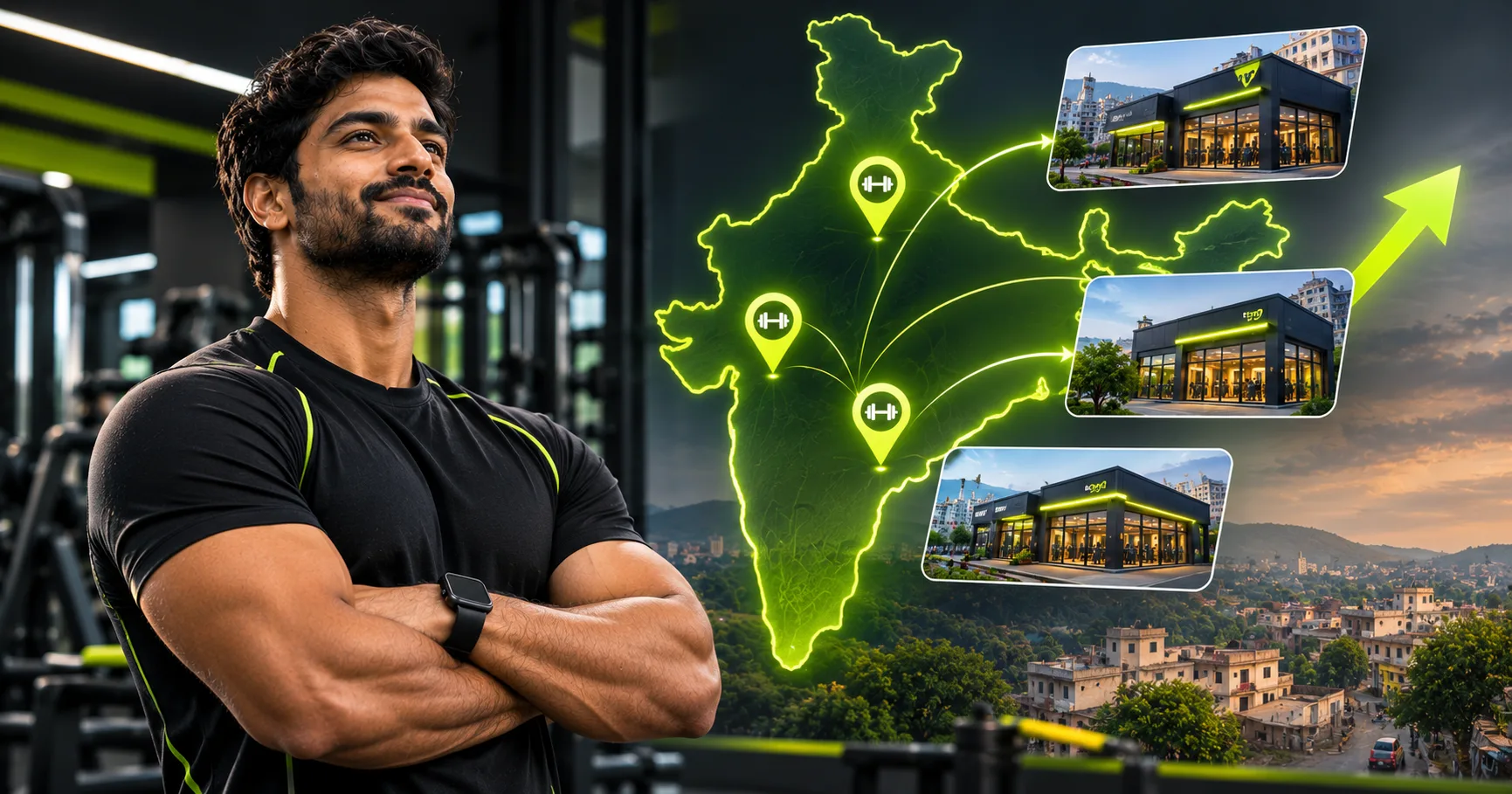
In India's saturated Tier-1 metropolitan markets—such as Mumbai, Bengaluru, Delhi NCR, and Hyderabad—the commercial fitness industry is locked in a hyper-competitive bloodbath. Commercial real estate rents have skyrocketed to ₹120 to ₹250 per square foot; micro-markets are overcrowded with five competing gyms in a single kilometer; and customer acquisition costs on digital channels continue to escalate. Gym owners in metros operate on razor-thin operating margins, constantly battling high employee turnover and price wars.
Meanwhile, an economic goldmine is expanding rapidly across India's Tier-2 and Tier-3 urban powerhouses: cities like Indore, Surat, Lucknow, Jaipur, Chandigarh, Coimbatore, Nagpur, and Patna. Fueled by high internet penetration, social media exposure, booming local entrepreneurship, and a burgeoning aspirational middle class, fitness demand in non-metro cities is growing at over 35% annually. With commercial real estate rents sitting at a fraction of metro costs and a hungry, loyal consumer base eager for modern lifestyle infrastructure, expanding into Tier-2 and Tier-3 markets is the single most lucrative growth strategy for fitness operators in India today.
The Unit Economics of Non-Metro Expansion: Low Overhead, High Profit
To appreciate why Tier-2 and Tier-3 cities offer superior Return on Invested Capital (ROIC), compare the foundational cost structures between a metro location and an emerging non-metro facility:
1. Commercial Lease Economics (The 70% Rent Discount): In Bengaluru's Koramangala or Mumbai's Andheri, a 4,000 sq ft commercial gym floor demands ₹4,50,000 to ₹7,00,000 in monthly rent. In Indore's Vijay Nagar or Lucknow's Gomti Nagar, prime commercial space with ample parking rents for ₹1,00,000 to ₹1,80,000 per month (roughly ₹25 to ₹45 per sq ft). That immediate ₹3.5+ Lakh monthly overhead saving drops directly to your net bottom line.
2. Pricing Parity & Aspirational Premium: While operating overheads in Tier-2 cities are 60% lower than in metros, consumer willingness to pay has achieved near-parity. A modern, air-conditioned, tech-enabled fitness center in Surat or Jaipur easily commands ₹1,800 to ₹2,500 per month (or ₹18,000 to ₹24,000 annually). You collect metro-level subscription revenues on small-town operating expenses, expanding EBITDA margins to an astronomical 45% to 55%.
3. Deep Community Loyalty & Low Churn: In Tier-1 cities, transient corporate professionals jump between boutique studios every six months. In Tier-2 cities, residents view their gym as a permanent community hub. Once trust is established, member retention rates routinely exceed 75%, and word-of-mouth referral velocity is unmatched.
Metro Trap vs. Gympify Tier-2/3 Expansion Model
Here is an operational comparison between the hyper-competitive metro market and the high-yield Tier-2/3 expansion model:
| Operational Metric | Tier-1 Metro Gym Facility | Gympify Tier-2/3 Expansion Model |
|---|---|---|
| Commercial Rent per Sq Ft | ₹120 to ₹250 / sq ft; high security deposit lock-in (6-10 months). | ₹25 to ₹45 / sq ft; modest security deposit (3-4 months). |
| Competitive Density | 8 to 12 competing gyms within a 2km radius; brutal price discounting. | 1 to 2 outdated local gyms; virtually zero modern, tech-enabled competition. |
| Trainer Retention & Staffing | Constant poaching; trainers jump ship every 6 months for small raises. | High loyalty; staff value professional training, stability, and growth. |
| Digital Payment Adoption | 100% digital; expects instant mobile app and turnstile entry. | Rapidly adopting UPI AutoPay; thrilled by metro-grade technology. |
| Payback on Initial CapEx | 28 to 36 months; high operational break-even point. | 12 to 18 months; rapid return on invested capital. |
The Step-by-Step Blueprint to Dominating Non-Metro Markets
Scaling successfully into Tier-2 and Tier-3 cities requires adapting your operational playbook to regional cultural dynamics.
Step 1: Secure Prime High-Visibility Hubs with Ample 2-Wheeler & Car Parking
In non-metro cities, private vehicle mobility is paramount. Never lease a secluded basement or a fourth-floor unit with broken elevators and zero parking. Target standalone commercial buildings or first-floor floors along major arterial boulevards (e.g., AB Road in Indore, Gaurav Path in Surat). Ensure dedicated parking for at least 30 two-wheelers and 10 cars; parking accessibility is the #1 amenity local families evaluate.
Step 2: Deploy Metro-Grade Hardware to Trigger Aspirational Prestige
Do not make the fatal mistake of treating non-metro consumers as 'second-class' by equipping the facility with outdated, cheap machinery. Install sleek biometric facial recognition speed turnstiles, vibrant neon lighting, and high-performance selectorized strength lines. When local residents see high-tech turnstiles that unlock via a custom-branded mobile app, the perception of prestige spreads like wildfire. Your facility becomes the definitive local status symbol.
Step 3: Establish Localized Trainer Academy & Upskilling
Finding certified personal trainers (ACE, NASM) in Tier-2/3 cities is challenging. Do not attempt to import expensive metro trainers who will get homesick and leave after 90 days. Instead, recruit passionate local competitive bodybuilders and athletes, and enroll them in a structured 4-Week Internal Coaching Academy powered by Gympify. Teach them kinetic movement screening, customer service hospitality, and ethical sales scripts. Local trainers possess deep community roots and will remain loyal to your brand for years.
Step 4: Cultural Programming: Festive Fitness & Separate Women's Hours
Respect local cultural nuances. In conservative non-metro districts, offering dedicated Women-Only Morning Hours (e.g., 10:30 AM to 12:30 PM) staffed entirely by female trainers and female housekeeping staff unlocks a massive demographic of housewives and young women who are prohibited from attending co-ed gym floors. Celebrate local festivals (Garba cardio in Gujarat, Teej workouts in Rajasthan) to build intense neighborhood affinity.
Step 5: Centralize Multi-Branch Operations via the Cloud
Managing non-metro locations from a central headquarters in Mumbai or Delhi is effortless with Gympify. You do not need to physically travel to Indore every week. Gympify's centralized multi-branch cloud dashboard gives you real-time visibility into every location: live turnstile check-in telemetry, daily retail POS sales, staff biometric clock-ins, and automated cash reconciliation—all from your smartphone.
Financial Payoff: Building a Multi-City Regional Dynasty
Opening three successful fitness clubs in Tier-2 cities requires the same capital expenditure as launching a single large metro facility—yet it yields three distinct recurring revenue streams totaling over ₹35 to ₹50 Lakhs in monthly gross turnover. By capturing dominant market share in emerging non-metro powerhouses, fitness founders build defensible, highly profitable regional networks that attract major private equity buyouts.
Key Operational Takeaway
Tier-2 and Tier-3 Indian cities represent the most profitable frontier of commercial fitness expansion. Combining 70% lower real estate rents with high consumer aspiration and metro-grade digital infrastructure enables gym operators to achieve 50%+ operating margins and 14-month CapEx payback. To manage multi-branch expansion, centralized analytics, and regional staff rosters, explore Gympify's multi-location enterprise tools or request an expansion consultation today.
Related Operational Guides
Accelerate your fitness brand's multi-branch regional growth with these interconnected resources:
- Managing a Multi-Branch Gym Chain in India: Master centralized audits, roaming access, and franchising.
- Franchise vs. Independent Gym: The True Cost Comparison: Build your own independent chain without paying franchise royalties.
- Biometric & RFID Turnstiles: Eliminating Proxy Check-Ins: Enforce automated security across remote branches.
Frequently Asked Questions
What is the average setup cost for a 4,000 sq ft gym in a Tier-2 Indian city?
A full-format independent commercial gym in a Tier-2 city typically requires between ₹65 Lakhs and ₹1.1 Crores in capital expenditure, depending on whether equipment is domestic or imported, representing a 50% savings over metro setups.
Will consumers in Tier-2 cities accept automated monthly UPI AutoPay recurring billing?
Yes. Digital payment penetration (PhonePe, Google Pay, Paytm) is ubiquitous across Tier-2 and Tier-3 India. Members readily adopt UPI AutoPay when offered affordable monthly pricing (₹1,500 - ₹2,200) instead of being forced into heavy annual lump-sum cash payments.
How should gym chains recruit qualified personal trainers in non-metro markets?
Recruit local athletes and powerlifters who possess strong passion and physical discipline, and put them through an internal 4-week certification program using Gympify's diagnostic movement screening frameworks. Local coaches have superior neighborhood rapport and lower turnover.
How does management prevent cash embezzlement in remote non-metro gym branches?
Enforce a strict 100% digital payment policy: all memberships and retail transactions must be processed via dynamic UPI QR or integrated card POS. When cash handling is permanently banned, front-desk embezzlement drops to absolute zero.